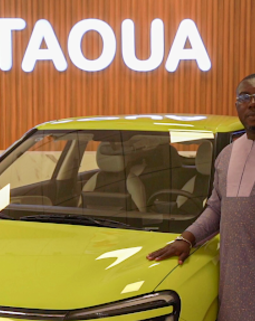


Burkina Faso has officially entered the electric vehicle market with the launch of the Itaoua brand, assembled domestically in Ouagadougou. Inaugurated in January 2025 with technical support from China, the assembly plant represents a major step in the West African country’s efforts to modernize its automotive sector and embrace cleaner mobility solutions.
The Itaoua lineup includes models such as the Sahel, Native, Tenakuru, and Land Elder, a pickup truck, all designed to be economical, sustainable, and technologically modern. This launch signifies Burkina Faso’s commitment to reducing environmental impact while improving mobility for its citizens. For the latest updates on African EV developments, visit AfricaCarNews.
Itaoua EVs: Combining Innovation and Affordability
The Itaoua Sahel, Burkina Faso’s most popular model, is a compact, fully electric car equipped with GPS, Bluetooth, and a solar charging system. It offers a range of up to 330 kilometers and can be charged in just 30 minutes at home or at fast-charging stations. With electricity costs ranging from 3,000 to 6,000 CFA francs per full charge — far cheaper than gasoline — these vehicles provide a highly cost-effective alternative for drivers.
Abdoulatif Rouamba, director-general of Itaoua, highlights that domestic assembly allows Burkina Faso to lower vehicle costs, increasing accessibility for the population. “Driving an Itaoua electric vehicle is a direct contribution to environmental preservation while maintaining affordability,” he said.
Solar-Powered Mobility for West Africa
Burkina Faso’s EV initiative is part of a broader government strategy to achieve energy sovereignty, create employment, and reduce dependency on fossil fuels. Solar-powered electric cars offer a dual benefit: cutting greenhouse gas emissions and addressing fuel management challenges. With approximately 30 electric taxis already operating in Ouagadougou, plans are underway to expand the fleet to over 100 vehicles, including app-based ride-hailing services.
Training and Technology Transfer
The partnership with China includes training Burkinabé engineers in Chinese factories. These technicians now apply their expertise locally, allowing Burkina Faso to gradually build domestic capacity for EV assembly. While the company currently focuses on assembly, it envisions launching its own vehicle designs in the future, further strengthening the nation’s automotive industry.
Economic and Environmental Impact
The Itaoua EVs are helping Burkina Faso address two critical goals: economic empowerment and environmental sustainability. By offering low-cost electric vehicles, the initiative encourages taxi operators, ride-hailing services, and private drivers to adopt clean energy solutions. This reduces operational expenses while contributing to a greener environment.
The Road Ahead
Burkina Faso aims to position itself as a regional leader in sustainable mobility. Rouamba projects that Itaoua will expand across West Africa and, eventually, to other continents. The electric vehicle sector is expected to create jobs, support youth employment, and modernize the country’s transport system.
The country’s embrace of Burkina Faso electric cars signals a growing trend in Africa: combining local innovation, international partnerships, and renewable energy to accelerate the continent’s shift to green mobility.
Are you ready to see West Africa’s streets electrified? Share your thoughts in the comments on how electric vehicles could transform transport in your city!